
Fixtures · 6 min read
Replacing a Kitchen Faucet in an Older Broward Home: Why the Shut-Off Valves Decide the Job
In Broward's 1970s and 80s houses the faucet is the easy part. The forty-year-old shut-off valves under the sink are what decide whether this is a half-hour swap or a valve replacement — here is how to tell before you buy the faucet.
By The God Plumber · Florida plumbers, in business since 2015 · Published · Updated
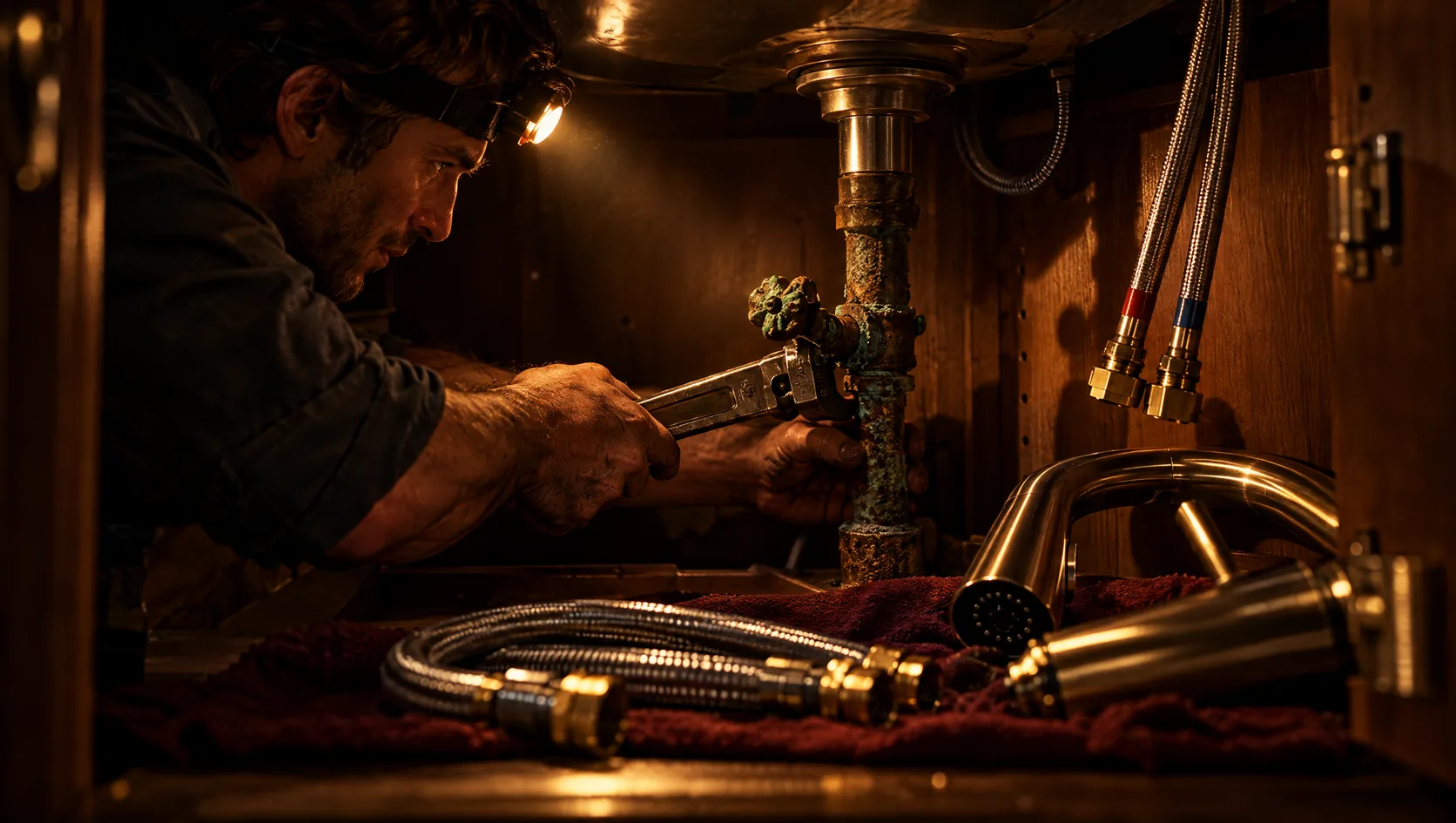
Replacing a kitchen faucet in an older Broward County home is usually a short job — unless the two shut-off valves under the sink have seized, which in houses built in the 1970s and 1980s they very often have. The faucet itself unbolts from above and the new one drops into the same holes. The part that decides the price and the time is underneath: if the original multi-turn stop valves will not close, or close and then weep, they have to be replaced before the new faucet can go on, and that is a different job from a faucet swap. Check the valves first, and you will know which quote to expect.
This comes up constantly in Broward because so much of the county's housing went up in one long stretch. Pembroke Pines, Plantation, Coral Springs, Davie, Cooper City, Miramar — whole neighborhoods were built between the late 1960s and the early 1990s, on slab, and a lot of those kitchens still have the stop valves the builder installed. Those valves were never meant to sit untouched for forty years, and hard water off the Biscayne aquifer has been working on them the whole time.
How do I check the shut-off valves before I buy a faucet?
Open the sink cabinet and look at the two small valves where the supply lines meet the wall or the floor. Then do the following, in this order:
- Look before you touch. Green or white crust on the valve body, a rust ring on the cabinet floor beneath it, or a supply line that is stiff and discolored all mean the valve is already on borrowed time.
- Turn the handle clockwise gently. It should close in a few turns without force. If it will not move, stop — forcing a seized multi-turn stop can snap the stem or shear the valve off the pipe.
- Open the faucet with the valve closed. Water should stop completely. A trickle that never quits means the valve is not sealing and will not hold while the faucet is off.
- Reopen the valve and watch the stem for a minute. A drip from the packing nut after it has been turned is common on old stops and usually means replacement rather than tightening.
- Check what the valve is attached to. Copper stub-out, galvanized nipple, CPVC, or grey polybutylene pipe — that decides which replacement valve fits and how the job goes.
If either valve fails any of those steps, the faucet swap becomes a valve job first. That is not a plumber inflating the work — a new faucet on a valve that will not shut is a faucet you cannot service, and the next drip has nowhere to go but the cabinet floor.
Why do old shut-off valves fail in Broward homes?
The valves under most 1970s–80s Broward sinks are multi-turn compression stops with a rubber washer and a packing nut. They fail three ways. The washer hardens and no longer seals, so the valve closes but water still passes. The packing dries out, so the stem leaks when the valve is turned. And mineral scale builds up inside from the county's hard aquifer water until the stem seizes in place. A valve that has not been operated in decades has usually done all three at once, which is why the very first time someone touches it is the day it fails.
The pipe behind the valve matters just as much. Homes from the 1978–1995 window may have polybutylene supply lines — grey plastic pipe that becomes brittle with age and reacts badly to being disturbed. A valve on polybutylene cannot simply be unscrewed and replaced; it needs the right transition fitting and a gentle hand, and it is a good moment to ask how much of the house is still on that pipe. Galvanized steel nipples from even earlier homes are often corroded thin at the threads and can break off in the wall when a valve is removed. Neither situation is a reason to panic; both are reasons to have the valve done by someone who has seen it before.
What does a kitchen faucet replacement include?
A proper faucet replacement in an older home covers more than the faucet, and a written quote should say so:
- Removing the old faucet, including the corroded mounting nuts that hold it from below — usually the slowest part of the job on a forty-year-old sink.
- Cleaning the deck so the new base seals flat; old plumber's putty and mineral crust prevent that.
- New braided stainless supply lines. The original lines go in the trash regardless of how they look.
- New quarter-turn ball-type shut-off valves if the old stops fail the checks above, matched to whatever pipe is behind them.
- Setting the faucet, connecting the sprayer hose and weight, checking for leaks under pressure, and running both hot and cold to flush debris from the new cartridge.
Quarter-turn valves are the right replacement in every case. They have no washer to harden and no packing to dry out, they close with a ninety-degree flick, and they will still work the next time someone needs to shut the water off — which, in a kitchen, is the whole point of the valve.
Should I replace the valves even if they still work?
If they pass the checks, no — leave them and save the money. If they pass but the house still has its original supply stops everywhere, it is worth doing the kitchen pair while the cabinet is already empty and the water is already off, because the second visit costs more than the extra ten minutes on the first. The same logic applies to a corroded basket strainer, a sagging drain trap, or a dishwasher supply on the same old stop: bundling the small work into one visit is how homeowners keep plumbing bills down over the life of a house.
Which faucet works best with Broward water?
Any well-made faucet with a ceramic disc cartridge will do; the brand matters less than the cartridge and the availability of parts. Hard water leaves scale on aerators and inside pull-down hoses, so a faucet whose aerator unscrews for cleaning and whose cartridge can be bought separately will outlast one that has to be replaced whole. Finishes are personal — matte black and brushed nickel hide water spots better than polished chrome on a Broward sink, which is the honest reason they are popular here.
If you are in Cooper City, Davie, Pembroke Pines or anywhere else in Broward and a faucet swap has turned into a valve question, call the South Florida line at 954-594-1666 or book a visit for a time that suits you. We will look at the valves and the pipe behind them, tell you honestly whether they need replacing, and put the whole job in writing before we start.